

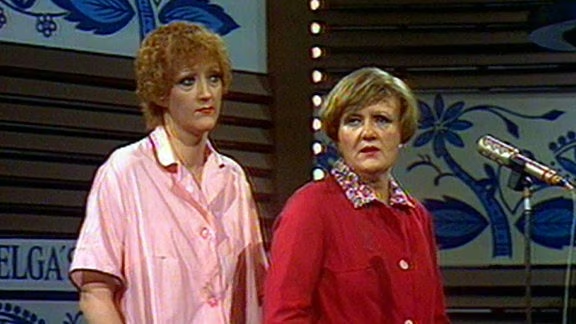
The phrase kinder von helga hahnemann can be confusing at first, especially for people who are not familiar with German culture or history. When translated word by word, it means “children of Helga Hahnemann.” Because of this, many people think it refers to her real children. That is not the case.
In reality, kinder von helga hahnemann is a symbolic and cultural expression, not a literal one. It is used to describe people who grew up watching, listening to, or being influenced by Helga Hahnemann, especially in the former East Germany (DDR). These people are called her “children” because her humor, personality, and values shaped how they saw everyday life.
Table of Contents
Who Was Helga Hahnemann?
Helga Hahnemann was one of the most loved television personalities in former East Germany (DDR). She was a comedian, singer, actress, and TV host. People knew her simply as “Henne.” She appeared friendly, honest, and very close to everyday people. That is why so many viewers felt she was “one of them.”
She was born in 1937 and became famous mainly through television shows in the 1970s and 1980s. At that time, TV was extremely important. There were only a few channels, so when someone appeared regularly on TV, almost everyone knew them. Helga Hahnemann used humor to talk about daily life, work stress, family struggles, and small joys. She never talked down to people. She laughed with them.
This strong emotional connection is one of the main reasons why the phrase kinder von helga hahnemann exists today.
The Cultural Meaning Behind “Kinder von Helga Hahnemann”
The term kinder von helga hahnemann represents much more than entertainment. It stands for a shared cultural experience. People who are called her “children” often share similar memories, values, and humor styles.
This phrase often describes people who:
- Grew up in East Germany
- Watched her shows as children or teenagers
- Learned to laugh at life’s problems instead of feeling bitter
Her humor was simple, warm, and human. It helped people cope with shortages, stress, and limits of everyday DDR life. That is why many say her “children” learned resilience through laughter.
In simple words, kinder von helga hahnemann means:
“People raised by a certain type of humor and mindset.”
How the Term Is Used in Media and Popular Culture
Today, the phrase kinder von helga hahnemann appears in:
- Articles about East German nostalgia
- TV documentaries
- Cultural discussions
- Social media posts
Writers and commentators use it to describe a generation that understands subtle humor, irony, and warmth. It is often mentioned when comparing East and West German media culture after reunification.
The term is rarely negative. In most cases, it is used with respect and affection. It highlights how powerful media figures can shape how people think, feel, and laugh.
Why People Search for “Kinder von Helga Hahnemann” Today
Search interest in kinder von helga hahnemann has grown in recent years. There are several reasons for this:
- Renewed interest in DDR history
- Documentaries about East German TV
- Younger generations researching cultural terms
- Confusion about whether the phrase means real children
Many people simply want a clear explanation. Others are researching identity, culture, or family history. The keyword often appears alongside searches about nostalgia, humor, and East German entertainers.
This makes the topic relevant not only historically, but also culturally today.
Common Questions About Kinder von Helga Hahnemann
People searching for this term often have similar questions. Below are short and clear answers.
| Question | Short Answer |
|---|---|
| Is it about real children? | No, it is symbolic |
| Is it a formal group? | No, it is cultural |
| Is the phrase still used? | Yes, especially in media |
| Does it relate to DDR life? | Yes, strongly |
| Is it positive or negative? | Mostly positive |
The Legacy of Helga Hahnemann and Her “Kinder”
Helga Hahnemann passed away in 1991, but her influence did not end. Her legacy lives on through:
- Old TV recordings
- Cultural references
- The phrase kinder von helga hahnemann
Her “children” are now adults. Many are parents and grandparents themselves. Yet they still remember her voice, her jokes, and her presence. That shows how strong cultural influence can be.
Her legacy is not about fame. It is about connection.
Final Thoughts on Kinder von Helga Hahnemann
The phrase kinder von helga hahnemann is a beautiful example of how culture works. It shows that influence does not need blood ties. Sometimes, a TV personality can feel like family.
In easy words:
- It does not mean real children
- It means shared memories
- It represents warmth, humor, and identity
Understanding this phrase helps people better understand East German culture, nostalgia, and the power of media.
FAQs: Kinder von Helga Hahnemann
1. What does kinder von helga hahnemann mean?
It means people who grew up influenced by Helga Hahnemann’s humor and TV presence, not her real children.
2. Did Helga Hahnemann have children?
She did not have publicly known children related to this phrase.
3. Is kinder von helga hahnemann a real group?
No. It is a cultural expression, not an organization or group.
4. Why is the phrase still used today?
Because people still feel emotionally connected to her and what she represented.
5. Is this term only used in Germany?
Mostly yes, especially in discussions about East German culture and media.
Mher Lesson: Almila Bagriacik Gewichtszunahme
